OZOMATLI:
And the Politics of Inclusion
By Claudia S. Meléndez
Photos by Janjaap Dekker

Los Angeles is a city of brewing conflict and latent dangers. It’s a city of extremes where the glamour and excess of the television Emmy awards rubs in the face of fasting workers protesting their lack of job security only a few blocks from the Shrine auditorium, the place where many self-congratulatory awards are presented. It’s a city where people ask you first your name, then your nationality. It’s a city of many wounds, a city that Ozomatli, a young band of diverse sounds, wants to heal through music.
It was only a few years ago that Ozo singer Wil-Dog took part in a labor dispute at the L.A. Conservation Corps, demanding better wages. The workers took over the Emergency Response Unit headquarters, now the Peace and Justice Center, and transformed it into a hub of political organizing and fundraising for the city’s myriad of needs.
It became Teotihuacán, the city where gods are made, for it was there where Ozomatli, Aztec name for the god of dance, was born.
Almost five years later, on a hot Los Angeles afternoon, the gods of dance prepared an offering of ear-shattering messages and musical politics in downtown L.A. Gathered in their traditional pre-concert huddle, the members of Ozomatli waited off-stage for the host to introduce them, a band of furious ideas with a conciliatory approach.
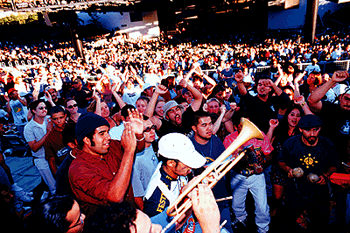
Once announced, Ozomatli broke into a fun, frenzied march through the crowded walkways of the California Plaza, pounding drums, slamming cowbells, blowing whistles, scratching woodboxes.

The experience of Ozomatli in a live concert is not easy paralleled. The group’s energy travels through the air, seeps into your cells and transmits life into your bloodstream. Their vitality draws you in, their love of music makes you dance. At the California Plaza, high school youngsters, elementary school children on a field trip, downtowners in businesswear, and tourists danced timidly, clapped eagerly, or sang loudly to “Cumbia de los Muertos,” “Como Ves” and “Changó.” Ozomatli attempts to unite people of this dysfunctional city, full of races from all over the world trying very hard to get along.
But Ozomatli is not only about music, party time and clean fun. Ozomatli is one of the strongest messengers of a new era of inclusive politics.
It’s part of the building of a social resistance movement that seeks solutions to homelessness, police abuse and poor wages. They are the standard bearers of a generation of Latino Americanos growing up side by side with Asians, blacks and whites, respectful of differences in background and aware of similarities.
Expressing tough political ideas is not always easy. Wil-Dog remembers how the band almost got booed off of stage in Philadelphia for dedicating their set to death-row inmate Mumia Abu-Jamal.
“It was one of the most important concerts we’ve ever had,” Wil says. “We are always playing for the converted, but this was a challenge, this is the challenge we live for. The crowd threw stuff at us, we were all alone, but out of all the people, about ten people in that audience had their fist in the air.”
“This is a revolutionary group,” an exited Fidel Rodríguez told a group of at-risk youth at the California Plaza. “They are going to change the world not by picking up guns, but by playing music.”
So far, no revolution has been organized in the name of Ozo, but the band is rapidly building a roll of followers ready to take up the cause. Although its first recording, Ozomatli (Almo Sounds) has had little air time on commercial radio, they have sold more than 130,00 copies. They tour year-round and have driven their audiences to a frenzy in Cuba, Mexico, and Europe. Alerted to their talents by one of his children, Santana invited the band to tour with him in his “Supernatural” tour this summer and has introduced them as the future of music.
“Ozomatli is one of those groups that’s going to make an inedible mark in the music community, not only in the Latino community,” says José Montes de Oca, manager of the broadcast department at KKUP radio in the Silicon Valley. “They represent the next wave of multicultural musicians.
“[The group] defies definition,” he continues. “In an industry like the music industry that always wants to define you, they defy that because they have a multicultural background. They are comfortable playing salsa, merengue, hip hop, everything in between. For that reason, they are making the cross-over much easier than others have in the past. They’re being accepted by more than one market, they’re going to be accepted by more than one audience.”
Children of the land of cellulloid, their music has graced the silver screen in cameo appearances on “Never Been Kissed,” and the HBO series “Sex in the City,” although they turned down an offer to record the original music to “The Road to El Dorado,” a Dreamworks animation set to debut next year.
“They just didn’t like the message,” says Amy Blackman, the group’s manager. The movie is a romanticized account of two European conquistadores who discover the riches of the so-called New World.
In their increasingly shrinking spare time, the guys of Ozomatli tour around schools to spread their musical message without instruments. They give talks in classrooms, offer music clinics, and offer the mirror of their life to young people growing up in the same neighborhoods as they did. Faithful to their anti-commercial creed, they’ve refused endorsements from popular soft drinks, blue jeans and other products.
With their love of music and devotion for political causes, Ozomatli is developing a style that includes each of the member’s musical preferences, ideas and original contribution. Not surprisingly, the music they are creating is a veritable ensalada, a mixture of cumbia, hip-hop, ranchera, funk, tejana, rapp, jazz, and whatever else you’d like to add for condiment. The group’s “Ozound” glides smoothly from the passionate flickers of Flamenco guitars to the rebellious scratches of the turn table. They rap to cumbias and scratch to rancheras. They jazz to merengue in English and Spanish. For the members of the group, there’s not limit to where their music can go.
“It came out very organically,” saxophonist Ulises Bella says about Ozomatli’s sound. “It wasn’t planned. Everyone has something that they loved and they put in the music.”

When you put together ten musicians, it’s hard to predict what you’re going to get. Ten different temperaments, musical tastes, ideas and predilections. José Espinoza, the group’s alto sax player, is a big jazz head, says Lalo Medina, the band’s tour manager. José rehearses all the time and worships John Coltrane.
Ulises Bella, who plays tenor saxophone, thrives on anarchy and chaos and has an eclectic taste in music. Asdru Sierra, trumpet player and one of the main vocalists, comes from a long line of salseros and regards Eddie Palmieri as the best salsa cat around. Raúl Pacheco, a former political consultant, likes the energy of country music, although he does not listen to it a lot. In fact, says Medina, he just wrote a country song. Jiro Yamaguchi, the king of Ozo’s percussion, was schooled in Indian classical music .
“The uniqueness of each one of us is important to us, just as much as making it work as a group,” says Raúl, the band’s lead singer. “We just accept each other.”
Accepting each other, and caring about one another is not an easy task to accomplish these days, especially if you want to take the caring beyond the group, which they do. In spite of the budget surplus and a bull stock market, the economic outlook has seldom looked bleaker for the working class. Inner-city youths face drugs, gun violence, unemployment and fewer opportunities for higher education. But for those dissatisfied dissenters who refuse to sit on the couch and be complacent, the time has never been riper to organize the growing masses of the disenfranchised. And they are doing so by organizing across racial and class lines.
“In some of the battles, like against police brutality, we find the effects cross all races and classes,” says Sash Reyes, an organizer with Refuse and Resist, a national organization that seeks to build a culture of resistance.
In Los Angeles as in many other large cities, issues like police abuse, death-row inmate Mumia Abu-Jamal, the Zapatista Army of National Liberation in Chiapas, Mexico, and labor struggles are bringing together throngs of young people who want to affect change. And even though cultures of resistance have been built before, this nascent movement distinguishes itself from the rest by its incorporation of different cultures.
“A lot of people compare it to the 60s but [then] it didn’t incorporate all cultures of America. I wasn’t there, but I feel it was more of a white people’s rebellion,” Wil-Dog says. “What we really need to do is to incorporate everybody, white upper class people with people from the ghettos, neighborhoods.”
“I have been an activist for a long time but haven’t seen this growing together (of different groups) before,” Reyes says. “It’s an indication that people are beginning to see that we have so much more in common than we think.”
For Ozomatli, what needs to change is people’s way of thinking, a shift from the current mentality that cares more about money than people.
“We want for people to be responsible for each other,” says Raúl. “There’s so much to go around in this world, why is there so much poverty? A lot of it is because people don’t care [about other people].”
Ozomatli, through its music, protests police abuse, promulgates battles of wit rather than guns, and predicts a coming revolution that will be televised. The group’s energy makes its ideas palatable, enjoyable.
Reluctant, as always, to bring the offering to an end, Ozo continued with a rambunctious batucada past the crowded hallways of the California Plaza, past a rainbow of smiling faces dancing to the endless encore. The guys settled in a cool niche under a staircase, away from the scorching heat, a perfect spot to sign autographs and continue the party just a bit longer, perhaps a bit louder. If any noise is going to transform L.A., surely it can be the sound of woodboxes, cowbells and whistles, noises of a dysfunctional city with many beautiful children.

© 1999, 2000 El Andar Magazine