cover story
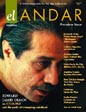
Olmos on
Fire
Edward
James Olmos talks about his work in Chiapas, the powers to come in the
next century and the difficult challenge of sainthood
by Julia Reynolds
I sometimes forget how
much people dislike us. Journalists, I mean. But I had an opportunity
to remember while chasing down Edward James Olmos at Universal Studios
in Los Angeles. I even had an appointment for this interview, but for
three days, the guy wouldn’t stand still.
He almost wore me out, but by Sunday I had a fierce glare in my eye that
said I don’t care what you think of us, I am getting this goddam
interview! I know you all hate us anyway, so I will live up to your worst
paparazzi nightmare and be in your face until you relent.
Though he was in the thick of presenting the second annual Los Angeles
Latino International Film Festival, Olmos graciously conceded, and what
follow are his thoughts on politics and the future — the words and
admissions of an inspired man in need of coffee.
I gave him my half a cup, though I needed it as badly as he. We’re
not all heartless.
The man who never sleeps now spends a great deal of time taking food and
medical supplies to the people of Chiapas. He recently managed to jam
on the congas with salsa star Marc Anthony at a White House reception
for Colombian President Andrés Pastrana. Olmos Productions, in
collaboration with the Foundation for Advancements in Science and Education,
is now promoting “It Ain’t Love,” a documentary about violence
against women. Eddie presented the ten-day-long Los Angeles Latino Film
Festival and is currently working in Toronto on a film called “Gossip.”
In between, there’s always dodging the threats on his life from California’s
Mexican Mafia gang (revenge for his movie “American Me”), sexual
scandals that seem to come up and are thrown out of court on a regular
basis, and alleged harassment from his wife Lorraine Bracco’s ex-husband,
Harvey Keitel.
Oh yes, and did I mention the “Americanos” project with the
Smithsonian? There’s the book, the traveling exhibition, the documentary
and the upcoming concert at the Kennedy Center that will highlight the
contributions of Latinos to American culture.
The convictions of a man who works and plays this hard must run deep,
and indeed, it turns out that Olmos aspires to nothing less than sainthood.
No wonder. Certain people devour life, and Olmos is one of those.
Not a lot of people know that Edward James Olmos once had a rock band.
“The Pacific Ocean” even cut an album, and eventually vanished
into history. But the interesting thing is that young Eddie named his
band after “the biggest thing on the West Coast.”

Your work in Chiapas —
I’ve read different pieces here and there about it, even in People
magazine. You said you don’t support the Zapatistas because of their
violent methods?
Olmos: I don’t support violence, period. I support the indigenous
people anywhere in the planet. I believe that Gandhi was correct. Non-violent
civil disobedience is the only way to bring about change that allows people
to enjoy the change and not get killed in the process. It’s very
slow, very, very difficult. But everything in my life that takes time
and that is hard [has been] the way to do it.
And why are you concerned with Chiapas? Los Angeles is where you live
and where you grew up.
Olmos: Chiapas is probably the main concern I have right now for the
planet. It’s about the diversity that makes this planet strong, that
is being neglected: we won’t have to worry about overpopulation or
ecology — diversity’s going to shut us down.
Our inability to relate to one another is very, very, very important.
When we don’t have it, we get situations like Bosnia. You get more
churches burned down in the United States in the last two years than in
the last hundred, because of the lack of understanding of culture and
diversity and the beauty of it.
What are you doing in Chiapas?
Olmos: We’re bringing in food, and awareness and medical aid.
Right now, forget it —thousands of people have died in the last three
weeks [after September’s massive floods]. Tens of thousands. We don’t
even know how many thousands and thousands have died. Nobody will ever
know because not only is the weather killing them, but now the government
is killing them. On top of the situation of [people] being disappeared
anyway, you hear “Oh, they were washed away with the flood.”
Right now they’re cleaning house.
Have you had problems with the Mexican government in your work there?
Olmos: Never. Never. I stay... away from them. I don’t deal with
them, they don’t deal with me. I just don’t deal with any government.
I don’t deal with the United States government. When it comes to
understanding humanity, they’re the worst.
How often do you go?
Olmos: Whenever I can. Sometimes two, three times a month.
What do you think is going
to happen next there? I mean, in the next year or two?
Olmos: Um. (Pause) The indigenous people will be decimated.
Decimated, meaning just plain —
Olmos: Destroyed. They will be wiped out. Yeah. And those that aren’t
wiped out will be indentured servants to the powers that be in that part
of the world.
There is a long pause before the conversation continues. Olmos has
been going to Chiapas since 1994, the year the state’s campesino
uprising against the Mexican government began. He fundraises all over
the U.S. to buy the supplies he takes into villages like Pohlo, where
10,000 refugees squatted this summer to escape reprisals after last December’s
massacre of 45 villagers in Acteal. Crops and villages all over Chiapas
were also devastated this year by military raids, catastrophic wild fires,
and finally, floods in the aftermath of tropical storms. Dysentery and
asthma are epidemic, and with the Mexican government’s recent crackdowns
on access privileges for foreign human rights workers and journalists,
even humanitarian aid does not easily get through.
Olmos’s entourages are among the few international groups that the
Mexican government currently leaves alone, no doubt due to his celebrity
and his strategic avoidance of political alliances.
It’s a painful silence shared. But of course, there are more questions.
And the U.S. press —
Olmos: Nonexistent. Reporters aren’t allowed in anyway. You can’t
get in. You can’t get a visa and you can’t get in.
As a prominent person who’s concerned about Chiapas, how successful
have you been in getting the U.S. press to pay any attention to it?
Olmos: Nationally, it’s very difficult. But locally, I do so
much traveling, I’m very effective. I’m probably the most effective
voice that they have right now in the United States.
Well, you did get covered
in People magazine...
Olmos: (Laughs) I had a choice, either taking the New York Times or
People magazine. I took People.
Good choice…
Olmos: Yeah, the New York Times is very intellectual and very,
very prestigious, but it doesn’t reach the market that People magazine
does.
In your opinion, as someone who works on this: what’s the most
effective strategy for improving this world-wide problem of divisiveness?
Olmos: One is teaching. Education is the key. But it’s the kind
of education that we teach that is the key. We don’t have it.
There is no way that we know what is going on between the African American
and the Asian American. We don’t understand what an Indigenous American
is. We don’t understand what a Latino American is.
We do understand very clearly what a European American is. We study that
95 to 96 percent of the time [from] our first grade through our twelfth
grade.
… Let me just put it to you this way:
I bring you to school, and I give you a hamburger for free, for lunch.
First grade. You’re gonna love me to death. You come walking in,
I hand you that McDonalds burger. Second day, I hand you that McDonalds
burger for lunch, you look forward to getting your hamburger! It’s
fantastic.
By the third or fourth year of having a hamburger every day, you’d
turn to the teacher and say, “Excuse me, but can’t we have like
a pizza, or like, a burrito or something else?” As much as you like
hamburger, if you eat it every day, you’re gonna get tired of it.
By the tenth, eleventh or twelfth grade, …I don’t know whether
you would hate the person who gave you the hamburger or not. But I do
know that you would hate hamburger, after eating it every day for twelve
years.
Well, that’s what happens when you feed European studies to non-European
children in a steady diet for twelve year of their lives every time they
go to school.
They may or may not hate the teacher, but they sure as hell are going
to hate white people.
At the rate we’re going, the 21st century looks pretty clear. It’s
going to be pretty violent.
You’re confident that
more and more, people are going to need to be multicultural and multilingual.
Will this override the forces that are trying to keep out immigrants and
their languages?
Olmos: Oh, it’ll destroy those people. Those people don’t
have a chance. Why do you think they’re fighting so hard right now?
This is the last hurrah.
It’s always darkest before the dawn, okay? Always darkest before
the dawn. Right now, the Anglo people are desperately trying to hold on
to the United States, like they tried to hold on to Africa. Not that their
homeland is going to be taken from them, but that they’re going to
have to share [the credit for] the contributions that make this country
great. You have to share the history here.
This not a “ white country,” never has been, never will be.
At one point, it was an indigenous country that has been permeated by
races from all over the world.
And, granted, for a long time, the European has been dominant in certain
parts of this Western Hemisphere, but by the end of the 21st century,
it’s over.
The dawn is here.
What should people do, knowing that these changes are coming?
Olmos: Well, they have no choice, okay? None of us have any choice
in this.
What we have to do is prepare ourselves. See, there’s no fighting
that has to be done, all that [is needed is] a peaceful understanding
of love, and a commitment to understanding what an Irish person’s
like, what a Russian person’s like.
What does the Lithuanian culture offer? What does the Ecuadorian culture
offer? What does the Guatemalan culture offer? What do people from Chile
really feel when they listen to people talk about Allende? What do people
of South Africa feel when they listen to words from Gandhi?
You said that the next century is going to be a hell of a century,
it’s going to be a difficult century —
Olmos: And a very optimistic, upswinging century. Because people of
color will definitely, definitely become the power base in the Western
Hemisphere.
What kind of leadership do you think Latinos need to get them through
the next century?
Olmos: Diverse. Diverse. We have to be able to understand that we
come in black, white, brown, yellow and red.
[Right now] we have Martin Luther King, and if it wasn’t for Martin
Luther King we’d have no people of color placed in the heroic position
as great people in this world. We don’t even have César Chávez
[in that position].
For me, César Chávez was a saint. Martin Luther King was
not a saint. He was a great man, he did great things, but he was not a
saint. César Chávez was a saint. Mother Theresa was a saint.
There’s a difference between Mother Theresa and Ethel Kennedy.
Both of them give of themselves, don’t get me wrong. You know, Hillary
Clinton gives of herself. Princess Diana gave of herself. But they are
not saints.
What makes a saint?
Olmos: A saint is a person who gives of themself without asking for
anything in return. That’s how simple it is to be a saint. Try it!
Try being a saint.
Have you tried?
Olmos: Shit, yeah. I try every day.
How’s it going?
Olmos: Don’t make it. (Laughs) Sometimes I make it, sometimes
I don’t. Some days, I get real saintly, man, some days like today,
I get real saintly. Today is a saintly day.
Why is that?
Olmos: Today [at the Latino Film Festival] I’m giving myself
to all these people and to my community and bringing all this and I’m
not asking for anything in return. Today’s a saintly day!
And that ego, that feel-good thing?
Olmos: I love it, man, are you kidding? Of course, that’s part
of the payback. You get to feel good. You get to feel some sense of self-worth,
self-esteem, self-respect. That’s worth more than a billion dollars!
And what keeps you from being a saint every day?
Olmos: God in heaven only knows. Whenever I turn around, I’ll
find myself thinking about something I shouldn’t be thinking about.
Like, God, you know, I’d love to have one of those .
Like those red shoes! (I
turn and say this to Claudia, who is photographing.)
Claudia: Yeah, I had a little guilt trip earlier.
And Eddie, no saint yet, knows exactly what we’re talking about.
Olmos: Yeah. Did you want those red shoes or what?

Jorge Chino
contributed to this report.
© Copyright 1998-99, El Andar Publication. No portion of this web site may be reporduced by any means without written permission from the publisher and additional copyright holders. All rights reserved.