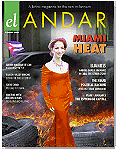
Miami's
Music War
Cuban Americans Terrorize Cubans to Keep Their Music Out of Miami
by Julia Reynolds
On a hotter-than-usual day in Bill Martínez’s San Francisco office, the Cuban band Bamboleo is blaring and phones are ringing. “You better make sure the group understands the visa problem,” Bill tells the caller. “They must know they’re not supposed to be in Miami.”
It’s the post-Elián era, and in Miami, emotions are still boiling. Local law says Cuban musicians can’t play there and now the Cuban government is telling artists their flights can’t even stop there. It’s an all-out culture war.
It’s ironic that Martínez, an immigration attorney who helps Cuban musicians set up tours in the U.S., can’t even book them into the country’s largest city of Cubans.
“This is so stupid,” Bill complains. “We shouldn’t even have to be talking about this today.”
Last October, Miami’s exile community did their best to stop a concert by the Cuban group Los Van Van that Bill helped organize.
It was like a scene from an abortion clinic. The militants showed up half a day early and waited for the glorious moment when they could throw bottles, cans, rocks and baggies full of excrement at the crowd attending the concert.
If Miami’s Cubans wanted attention, they got it. Though they didn’t shut down the show, they managed to create a mini-riot scene and, most importantly, get tons of press. Police in riot gear escorted concert-goers past a screaming crowd, and there were a few arrests. One reporter was injured when a rock hit him in the head.
Before the concert, Miami Mayor Joe Carollo helped feed the frenzy on radio talk shows, lashing out at concert promoter Debbie Ohanian.
“Havana Debbie knows this isn’t about bringing Los Van Van to Miami,” he said. “This is about trying to cause problems in Miami and making Uncle Fidel happy.”
Ohanian counters that the mayor had simply decided to make her life “a living hell,” by trying to block the concert with paperwork and bureaucratic tactics that in the end didn’t hold up.
“Miami is run by politicians,” she says, “one more crooked than the next.”
Not all performers are willing to brave the mobs like Los Van Van did. The Buena Vista Social Club canceled a Miami appearance last year.
“A lot of the members of that group are too old to be putting up with that stuff, and they would face serious physical problems,” says Martínez. “It’s unfair and it’s real sad.”
Showcasing Cuban artists in South Florida has long been a risky business. But the situation got worse after February 1996, when planes flown by “Hermanos al Rescate” were shot down over Cuba. From then on, all things connected to Fidel’s country were considered fair targets in the war.
In April of that year, 200 protesters harassed and spat on concert-goers who went to see Cuban jazz pianist Gonzalo Rubalcaba.
Then in August, 73 year-old Cuban diva Rosita Fornes turned around and went home. Her venue had received bomb threats, and the city raised its fire insurance and security fees.
Fornes had previously canceled a sold-out Miami tour because someone threw a firebomb into the nightclub’s window. The club was shut down.
“It’s very unpleasant that this is happening at a stage of my life when I … only want to share with people who offer me their love,” she said.
Fornes did come back last year, and sang at Starfish, Ohanian’s private night club in the hip South Beach area, where exile protesters rarely go. “Everyone there would just think all these screaming people in the street were some kind of perfomance art,” Ohanian says.
In 1996, Miami-Dade County passed what’s known as the Cuba Ordinance (technically, the “Cuba Affidavit”). It goes beyond the embargo by forbidding the use of county facilities and funds to anyone who has done business in Cuba, or anyone who did business with anyone who did business in Cuba. Or to organizations whose staff, members, directors or investors have visited Cuba in the last ten years. The rule is particularly potent against performers, because it prohibits Miami from providing police and fire services in venues that receive public money, which means most of the city’s major arenas.
Miami’s Cubans are divided over the ordinance. Liberal Cuban-Americans complain that the entire community has been unfairly portrayed as the “Miami Mafia,” a screaming rag-tag army of hard-liner, anti-Castro nuts. A Miami Herald poll last year showed there is a generational difference: Sixty-five percent of the over-fifty crowd opposed performances by Cuban groups in government-owned venues, while only 31 percent of those under age fifty did. But the right-wingers often succeed in hushing up the young and the liberals, quickly and loudly.
The irony is that free speech is an issue dear to the exiles’ hearts. The Cuba ordinance even refers to it: “The government of the country of Cuba continues to maintain a policy of denying common freedom of speech, press, assembly, religion, and human rights to the majority of their citizens. Until this policy changes, Miami-Dade County shall not enter into a contract with any person or entity that does business with Cuba ... or that has traveled to Cuba.”
Now the ordinance is being challenged legally as a violation of free expression and association. Last April, a lawsuit was filed by the American Civil Liberties Union (ACLU) on behalf of five arts groups and promoters, including Debbie Ohanian, on the grounds that it violates the First Amendment.
The ordinance has also cost the city a lot of money. A major Latin American music trade show, Midem, was shut out in 1997 because it included Cuban artists. Midem worked around the rule the next year by staging in the more liberal city of Miami Beach, and by privately raising the $200,000 needed for security and insurance.
But Miami lost millions in potential revenue when it missed out on hosting the upcoming Latin Grammy Awards.
Bill Martínez sat in on a Los Angeles planning panel last fall, when it was not yet decided if Miami or L.A. would host the prestigious event. After a discussion that included the Grammy organization’s Michael Greene and Emilio Estefan, the panel was opened to questions.
“I raised my hand,” Martínez recalls. “I said… ‘Well, if these Latin Grammy awards are going to take place in Miami, what is the position of this body on allowing Cuban musicians to share the stage at this awards show?
“‘We’ve just gone through the war of bringing Los Van Van to Miami. We had all of our audience members have rocks and bottles thrown at them. Are we going to experience that again?’”
Emilio Estefan’s statement was ambiguous. “It’s about music. As an American, it’s nice to have the freedom of speech, to welcome everybody to this country. As a Cuban, my heart is sad with what’s happening in that country.”
Martínez says Estefan went on to say that he would not “support a dictator, or music that comes from the dictator’s house.” If Cuban musicians were going to be part of that awards presentation, Estefan said, he would not do anything to stop it from happening in Miami, but “he certainly was not going to support it, because he doesn’t support dictators. And that was it.”
“It felt like twenty percent of the room clapped for him, like ‘Right on, Emilio, tough guy!’” Martínez says. “I was slightly discouraged, but afterward everybody came up to me and said, ‘Bill, you said something that was on my mind, too.’
“So even there, it makes you wonder how intimidated folks are about saying something, even in a setting like L. A. ’Cause you don’t mess with the Miami Sound Machine. It is a sound machine in more ways than one.”
Either because of the Cuba Ordinance or because nobody holds a major music event in South Florida without the blessing of Emilio Estefan, Miami lost the Latin Grammies. And it lost $40 million in potential revenue.
Greene blamed the Cuba Ordinance. “At the end of the day,” he told the press, “when Miami-Dade County would not only not provide the American Airlines Arena but also wouldn’t provide any cultural support for the education programs, it was quite obvious that it wasn’t going to happen.”
Miami-Dade Mayor Alex Penelas (the county also has a mayor), continued Estefan’s line of double-talk, claiming he never fought the Grammies, but he didn’t at all like the idea, either. “This is a free country. No one says [the Grammies] can’t come. All we’re saying is we can’t use county resources.”
“It would bother me personally if Cuban artists who are in some way representative of the Cuban government are highlighted in an event like this,” he added. “Of course.”
Of course, not every anti-Castro Cuban in Miami is anti-culture. Gloria Estefan was branded a Communist by the far-flung fringe when she defended Peggi McKinley, member of a county media advisory board. McKinley had challenged the Cuba Ordinance, and she was fired for it.
‘’I felt insulted that the woman was removed from her position for expressing an opinion,” Gloria told the South Florida publication Exito. “I said to myself, this is not the United States.’’
Still, like Mayor Penelas, the Estefans walk a fine line between supporting the Cuban musicians in theory, and not supporting them in practice. They know that when they withhold support, their money and their clout do most of the talking.
That clout has not gone unnoticed. Two years ago, the Mexican pop-rock group Maná was nominated for a Grammy, but they boycotted the awards. The group caused a minor scandal when they told the press that the Grammies were a front for “a Mafia called the Estefans.” Maná’s leader Fher added defiantly, “We’ve been in Cuba. We went to soak up their music.”
Willie Chirino is one of the rare Miami stars who stands up for musicians from his homeland. Chirino had already been wrung through the “music police” ringer in 1996, when Sony Discos previewed a video of his in front of Jose Basulto, the controversial head of Hermanos al Rescate and a former CIA associate who once fired a cannon at a Cuban hotel full of Russians.
Basulto was unhappy with images of Chirino walking along Havana’s Malecón — not the real Malecón, of course — and flirting with jineteras, the city’s ubiquitous prostitutes and fun-seekers. “The video,” Basulto complained, “did not confront the Cuban government about the prostitution it has created.” It was not released.
Then a TV news reporter found out last year that Chirino had jammed a few times with Los Van Van. Chirino admitted that yes, he had played with the Cuban musicians, and he responded firmly: “Those people are not my enemy. They are not your enemy. Only Castro is the enemy. And I resent anybody doubting my Cuban-ness or my position as a free Cuban.” The Miami Herald reported it exultantly, as if Chirino were the city’s savior: “At last, the skies parted. For the first time since the furor over Los Van Van began, the complex and compelling truth about Cuban Miami came shining through.”
Recently, Cuba escalated the war. Martínez says that lately the Cuban government will only grant visas with the
provision that artists do not perform or even stop over in Miami, citing concern for the safety of the performers. Now the muscians have taken the conflict a step further: some Cuban bands may have violated the proviso by performing in Miami anyway.
Meanwhile, the Miami ACLU won a victory in late May when Judge Federico A. Moreno allowed the five arts groups to submit grant applications without signing Cuba Affidavits. The court also noted that the Cuba Ordinance might soon be ruled unconstitutional.
But in many ways, the hard-liners have already won the battle.
“In this town,” says Debbie Ohanian, “if you have an opinion, you just keep your mouth shut. Because everyone does business with [the hard-liners]. Or they’re your neighbors, or they’re relatives or friends.”
“Most of the major promoters and producers of these tours see the writing on the wall,” says Martínez. “They see the war we went through with Los Van Van, and for many, if not all of them, Miami is not even close to being on the agenda. It’s just not worth it to us.
“So they got what they wanted. They don’t want any Cuban artists.”
Others, like musician Chucho Valdés, are not ready to give up.
“I think it’s important to play in Miami because it’s the place after Cuba with the most Cubans,” Valdés has said. “The music belongs as much to them as it does to us, because we share the same roots.”
As a man on the front lines, Bill Martínez has other realities to face. A Chicano California-New Mexican, Martínez gets upset when asked if Cuban Americans have too much influence over the Latino agenda in the U.S.
“I am absolutely pissed off,” he says. “I think the abuse of the media by the Miami folks is so upsetting, so unfair, that at some point I wish that the rest of the Latino community, the Hispanic community, the Chicano community, that all the others outside of the Cuban-American community would rise up and speak up.
“I’m so tired of that b.s. I’m so tired of them dominating the analysis of Cuban-American relations, and, ultimately, the culture.”
At a 1998 Midem concert in Miami, a 90 year-old member of the Buena Vista Social Club stopped singing to talk to the crowd, his voice raised over the rhapsodic rhythms.
“Music doesn’t bother anybody. Music is music!” Compay Segundo shouted.
How right, and how wrong, he was.
Julia Reynolds is editor of El Andar.
© 2000 El Andar Magazine